October Recap - Exploring School Finance & District Growth
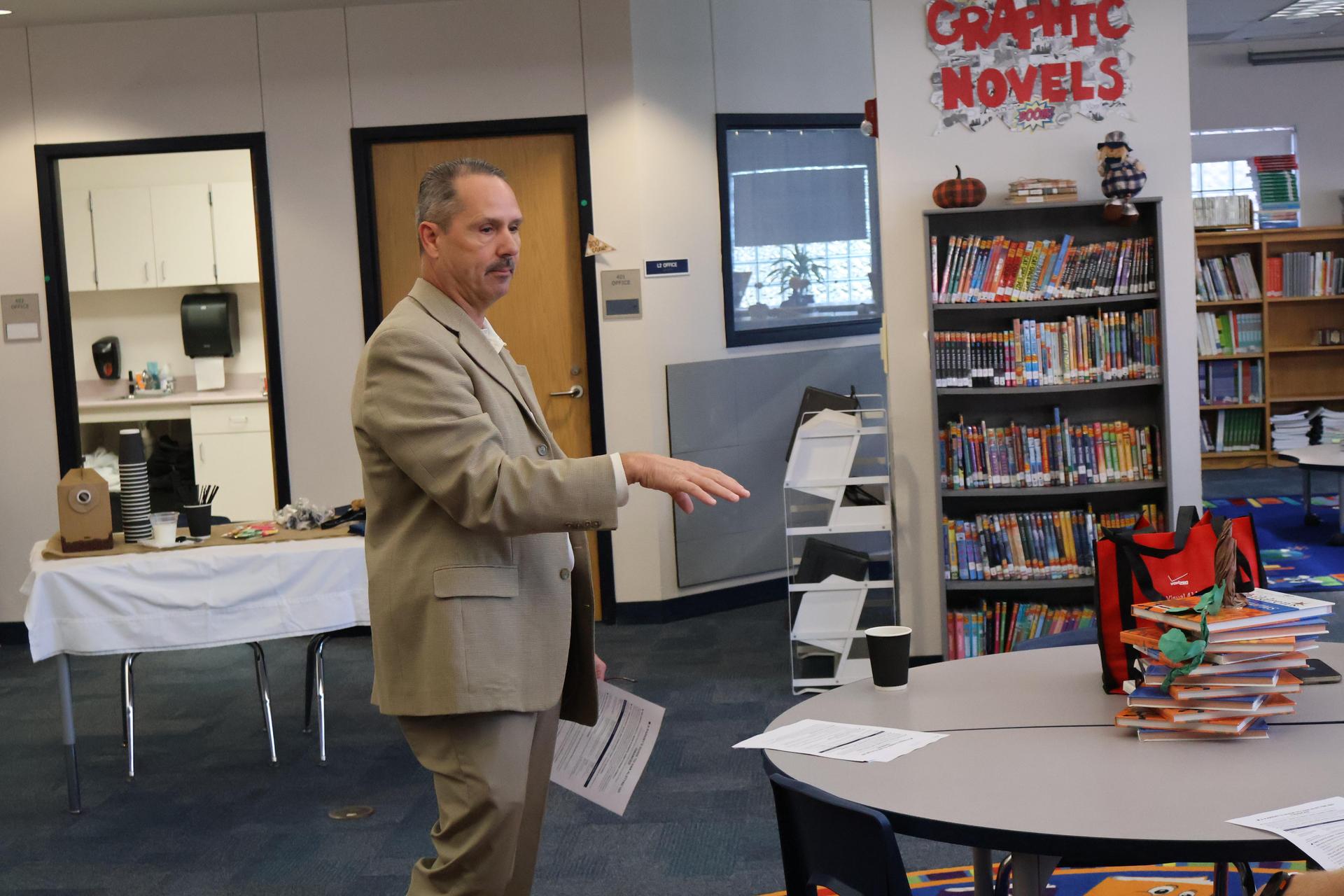 Van Alstyne ISD Superintendent Dr. David Brown met with community members Oct. 8 in the Partin Elementary library for Coffee & Conversation, offering an overview of school finance and answering questions about district funding, instructional resources and future facilities.
This month’s topic, “Understanding School Finance,” explored how the district balances continued enrollment growth, rising costs and funding requirements while supporting students and teachers.
Brown said VAISD has grown from approximately 1,800 students to about 3,000 over the past six years. That growth requires additional staff, classrooms, transportation and instructional resources. He emphasized the district’s commitment to maintaining manageable class sizes to support student learning.
Opening Williams Elementary was part of that effort. Brown said the new campus added approximately $3.66 million in annual operating costs and was a major factor in this year’s deficit budget. He explained that a new campus creates immediate operating expenses, while additional enrollment helps support those costs over time.
Understanding School Funding
Brown described school finance using two separate funding “buckets”: maintenance and operations (M&O) and interest and sinking (I&S).
M&O supports daily expenses such as salaries, classroom supplies, utilities, transportation and routine repairs. I&S supports repayment of voter-approved bond debt. Brown emphasized that funds designated for bond projects cannot be redirected to cover daily operating expenses or teacher raises.
He also explained that bond projects are scheduled based on facility needs and the district’s ability to repay debt. Voter approval authorizes projects but does not mean every project can begin immediately.
The presentation addressed how property values and attendance affect funding. Brown explained that higher local tax collections do not automatically produce additional operating revenue because state funding calculations account for those collections. He also discussed recapture (commonly referred to as "Robin Hood"), through which VAISD sends a portion of local revenue to the state to support education statewide.
Student attendance directly affects funding, while expenses such as staffing and utilities continue regardless of daily attendance. Brown encouraged consistent attendance when students are healthy and discussed how rising costs create additional pressure on the district’s budget. As an example of those rising costs, Brown said a school bus that cost approximately $100,000 in 2019 now costs about $190,000.
Community Questions and Discussion
During the Q&A, attendees asked about tax rates, district reserves, instructional materials and future campus needs.
One question addressed why the district could not lower its tax rate if state funding is based on attendance. Brown discussed how state funding calculations and property-value information influence the district’s operating tax rate and revenue.
He also explained how the district maintains a fund balance to help address budget shortfalls, unexpected expenses and planned replacement costs. Brown said VAISD has approximately $11 million to $12 million in fund balance and described setting aside money for anticipated expenses, such as major air-conditioning repairs and turf replacement.
One attendee asked whether printing selected pages instead of purchasing complete Bluebonnet math workbooks could reduce costs. Assistant Superintendent Dr. Jamie Martinez explained that the printed materials are supported by designated funding that cannot be redirected to other operating needs. Additionally, printing materials locally would shift the expense to a different funding source.
Martinez explained that instructional material costs are reviewed periodically, citing a previous decision to replace certain handwriting workbook purchases with resources teachers can print as needed.
On facilities, Brown said the district recently received donated land at the Churchill site for a fourth elementary and anticipated further discussion at the upcoming board meeting. He also discussed the goal of returning fifth grade to elementary campuses as additional capacity becomes available.
Asked about expanding Partin, he noted that campus size, traffic flow and access must also be considered.
Another community member asked about programs for homeschooled students. Dr. Brown said the district does not offer an at-home online instructional option and emphasized its focus on face-to-face instruction.
Asked about the district’s ability to provide input on state decisions, Brown discussed the district's experience working with TxDOT on traffic planning near new school campuses. He said the district completed a traffic study before construction of the new high school, but another study was required after the campus opened and congestion developed. The district and city then worked together to help move the project forward.
Brown also discussed Williams Way, saying a traffic study was completed before Sanford Elementary opened, but the resulting traffic improvements took six years to put in place.
Coffee & Conversation provides community members an opportunity to learn about district operations, ask questions and speak directly with the superintendent.
Our next Coffee & Conversation will be at 9 a.m. Nov. 12 in the Williams Elementary library. The topic will be “Student Achievement.” We hope to see you there!


